
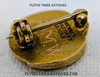
Wonderful circa 1913 - 1914 US Aviation Reserve 14K Gold Member Lapel Pin of Pioneer Aviator Roderick M. Wright

- SKU:
- mca10034rmw




Description
ARTIFACT:
From the Smithsonian Institute’s Website:
RODERICK M. WRIGHT
Early Wright Pilot - Instructor - Test Pilot
Roderick M. Wright was born on a farm near Washington, Indiana, March 24, 1887. He was no relation to the Wright Brothers. Being the only son of his widowed mother, he grew up fully expecting to be a farmer, and in 1908 entered Purdue University to study Agriculture. While there, he read an article in McClure's Magazine entitled "The Men who Learned to fly", and this fired his ambition to learn more about aviation, which was to take him away from the farm and result in greatly influencing the course of his life. The more he thought about it, the more interested he became. On June 9, 1911, Wright saw his first flying when he went to Evansville, Indiana to see Curtiss pilots Lincoln Beachey and Charlesy Witmer put on an exhibition. There, the aviation bug really bit him when he saw Beachey fly over the city and Ohio River.
Following this, Wright made arrangements to go to Dayton in July, 1911, to visit the Wright Brothers, and planned to enroll in their flying school at once, if possible. When he walked into the Wright Co. office entirely unexpected, Wright was very disappointed to learn that neither of the Wrights were in Dayton, so he talked to Frank Russell, who was their Manager at that time. For some unknown reason Russell advised Wright not to take up flying, but to stick with the farm. Somewhat disgusted, but not the least influenced by these remarks, Wright went home and spent the greater part of the next two years helping various early Indiana experimenters build and repair their home-made machines, without pay, "just to get experience and be around aeroplanes." During the latter part of this period, he worked as an engine assembler for the Kemp Machine Works, Muncie, Indiana, builders of a line of early aircooled aviation engines. While there, Wright also assisted in building another home-made aeroplane. Through this early experience, he learned much about planes and engines but still had no opportunity to learn to fly.
In July, 1913, Wright went to Dayton again and this time met a very different sort of reception and, as a result, immediately signed up for instruction at the School, and was taught to fly at Simms Station by Wright instructor Oscar Brindley. In the same class were John A. Bixler, Maurice T. Schermerhorn, W. E. Bowersox and Augustus A. Bressman. Wright, having a good background for instruction, quickly proved an exceptionally apt pupil and gained the "feel of the air" rapidly. On July 26th he flew for his license, No. 254, at Simms on a Wright Model B school machine, going through the tests like a veteran, stopping within 5 feet of the mark on his spot landings, to become Indiana's first licensed aviator. Grover Loening, then Chief Engineer for the Wright Co., was his official observer. Flying jobs were scarce, so he took his new license and became a mechanic on the exhibition circuit with Roy White, of Boston, for the remainder of the 1913 season.
During 1914 Wright did considerable flying, using a Wright Model B on floats, and assisted in the flying and development work being conducted by the Wright Co., with their new Model C flying boat on Lake Erie, at Toledo, Ohio. In 1915 he became an instructor for the Wright Co. at Simms and taught many Canadians, who later entered the R.A.F. in World War I. Included among his students that year were several from the United States, some of whom were to become world renowned figures in aviation. One of these was Edward A. Stinson.
In 1916, Wright was again instructor for the Wright Co., first with their Southern school at Atlanta, Ga., in the early spring, then later at Dayton, the last year they operated their famed school at Simms on those historic flying grounds. Later that summer he did some flying for the Rhode Island Naval Militia, and in September joined the staff of the Sturtevant Aeroplane Co. of Jamaica Plain, Mass. as test pilot, working for his former friend, Grover Loening, who was then Chief Engineer there. On September 18th he test flew a new Navy Sturtevant plane at the Atlantic Aviation, Field, Boston, Mass., and on October 18th flew a Sturtevant plane on an extended test flight which took him over Quincy, North Weymouth, Nantasket Beach, Boston and Jamaica Plain, at times reaching 12,000 ft. altitude.
Remaining with Sturtevant until World War I in 1917, he offered his services to the Government, first as a civilian instructor, then later was assigned as experimental test pilot at Langley Field, Va., where he remained for the duration of the war period. After that followed several years of instructing, barnstorming and passenger service work, with some testing with various small Companies, including the Hurst Airplane and Motor Company of Evansville, Ind. in 1921. Wright also managed the Graham Bros. Flying Field at Evansville for a time, and later became production test pilot for the Stinson Co. at Wayne, Mich. in 1929-1930, working for his good friend and former pupil, Eddie Stinson. There he conducted initial flying tests on many of their new models, and delivered new planes to customers about the country on occasion. Later, in 1930-1932, he became transport pilot for the Ford Motor Co. on their early airlines using Ford Tri-motored planes. While there he obtained Transport Pilot License No 4528. Following this, Wright was pilot for the Hudson Motor Co. for a time in 1932.
After twenty years of active flying, in 1933 Wright decided to return to the family farm. There he prepared his private airstrip, erected a hangar, procured a family aeroplane and continued to enjoy flying for pleasure. He taught his children and grandchildren to fly and kept his original Pilot License No. 254 valid for nearly fifty years. Occasionally he took on flying contract work, and during World War II conducted parachute drop tests for The Reliance Mfg. Co. In 1952 he as elected to the State Legislature and was re-elected for a second term in 1954.
On October 13, 1960, Roderick Wright passed away unexpectedly at Washington, Indiana, after several months of failing health. He was buried in Oak Grove Cemetery near his farm home. Surviving were Mrs. Wright, three children and six grandchildren.
An active Early Bird and true flying pioneer, it would have been difficult to equal his lifetime record in aviation, having flown scores of different types of land and water planes, large and small, and not long ago even a jet. During his long active flying career he experienced five major smash-ups, but walked away from all of them. He never used a parachute, injured a passenger, nor was taken to a hospital - truly an extraordinary record. A fine gentleman, loved by all who knew him, he rightfully deserves everlasting credit for his long and devoted service to aviation and the many valued contributions he made in American aviation progress. His name appears on the Wright Memorial Plaque at Dayton with the many others who learned to fly there.
Research Paper Submitted as Part of the Indiana State Historical Marker Application, 1996:
Roderick M. Wright was born March 24, 1887 in the house built by his grandfather in 1863. He passed away in the same house on October 13, 1960.
Rod Wright learned to fly on July 16, 1913 at the Wright Brothers School at Dayton, Ohio with Oscar Brindly as his instructor. On July 28, 1913, Grover Cleveland Loening as the observer passed Rod Wright on his flying ability. Thus the Aero Club of America issued him the F.A.I. License No. 254
In 1915, Orville Wright asked Rod Wright to be one of his instructors at his school in Dayton, Ohio. While he was an instructor, he taught Edward Stinson, who was to be the founder and owner of the Stinson Airplane Company, and Roy Brown, a Canadian, who shot down the German Ace Richthofen in World War I. Mr. Wright was the test pilot for the Sturtevant Company at Boston, Mass. in 1917-1918. He was a test pilot for the War Department in 1917-1918. While there he flew monoplanes, biplanes and triplanes. While there he also flew two planes at the same time, using radio controls. He was the first man to accomplish that feat. In 1929- 1930 Rod was test pilot for the Stinson Company. During his flying experiences he has flown around 500 different planes. In 1929-1930 he held ratings in five different weight and power categories. He flew for the Ford Motor Company in 1931 and in 1932 flew in the Ford Trimotor. He worked for the Hudson Motor Co. and put a Hudson Terraplane car motor in a Curtiss Robin airplane to promote the Hudson Cars.
During World War II he had the contract for drop testing parachutes made by the Reliance Manufacturing Company in Washington, Indiana. With 5,500 takeoffs and landings, some 11,000 parachutes were tested on his farm. When he was 67 years old, he flew the fastest plane in his career, a T-33 jet.
Submitted by his son,
Roderick R. Wright, of Washington, Indiana
VINTAGE:
Circa 1913 – 1914.
SIZE:
Approximately: 1/2 in height x 1/2” in width.
CONSTRUCTION / MATERIALS: 14K Gold.
ATTACHMENT: Vertical Pin with drop-in locking catch.
MARKINGS: MERMOD JACCARD & KING / RMW
ITEM NOTES:
This is from a US Aviation collection which we will be listing more of over the next coming months. CON-JGB-25-25 LAFGEX06/03/26
CONDITION:
9 (Excellent - Near Mint):
The wing shows slight wear, overall, it is in excellent condition.
GUARANTEE:
As with all my artifacts, this piece is guaranteed to be original, as described.
Related Products
Related Products

Sterling Circa 1930s Aviation Lapel Pin

Circa WWI US Air Service Sweetheart or Lapel Pin in 14K Gold

Circa 1920s Aviation Lapel Pin in 10 Karat Gold<p> NO LONGER AVAILABLE

1930s Goodyear Aviation Lapel Pin
